
BACKWATER
A Tale of Salt, Timber, and Unbroken Duty

The tide did not care that Eben Junkins’ knees were stove up with the salt-damp. It did not care that he had slept only three broken hours in a narrow cot above the saw-rig, or that his left hand was swollen to the size of a cod-head from a jammed pike pole.
Above the saw-rig, the keeper’s cottage held the shape of a life narrowed to duty: a cold stove, a table scarred by knife marks, one chair polished smooth by years of Eben sitting awake between tides, boots still on, listening for the first wrong note in the water below. The bed in the corner was never fully slept in; its blanket lay kicked aside in the permanent disorder of a man who woke by fear before any clock could wake him by bell.
The moon had shifted its mark by fifty minutes, as it always did, pushing the turn of low water into the black, freezing gut of 3:15 AM.
Down in the dark pit of the York River installation, the Atlantic was holding its breath.
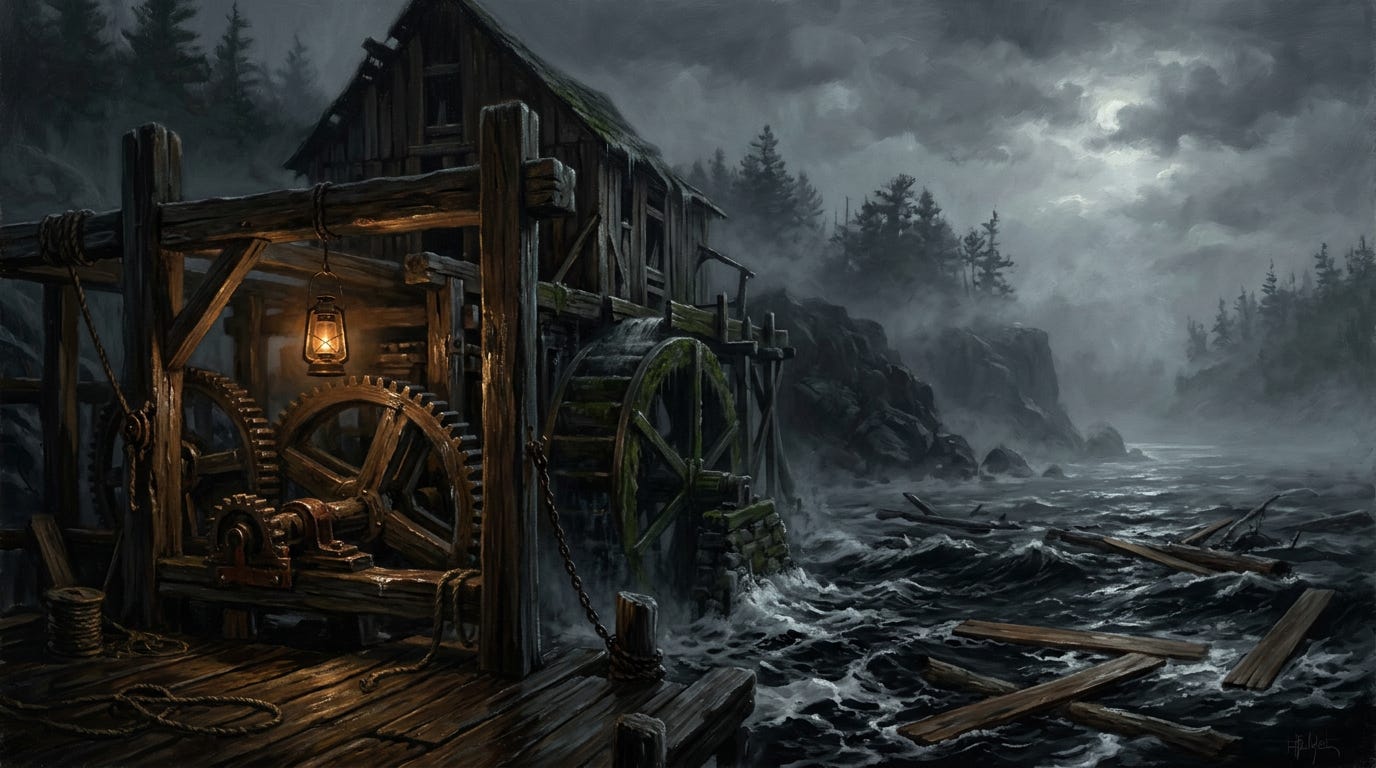
Eben stood on the dripping hemlock water-deck, his feet planted wide in sodden leather boots. A single brass kerosene lantern hung from an iron hook above his head, casting a sickly, amber circle across the massive oak machinery. The air smelled of rotted bladderwrack, wet sawdust, and cold mutton tallow.
Clack-clack-clack-CRACK.
The iron pawl slammed into the teeth of the main winch drum.
Above him, behind the heavy, stone-weighted timber dam, twenty thousand tons of black water pulled from Old Mill Creek were pushing against the swinging sluice gates. The mill pond was full to the brim—a dark, stagnant mirror choking on drowned spruce logs and ancient mud.
Eben spit a dark thread of tobacco juice onto the wet timber. “Go on then, ya gawmy bastard,” he growled into his collar, his voice raspy from cold smoke and night air. “Muckle onto it.”
He wrapped his raw, calloused hands around the four-inch oak pry-bar.
The protocol was absolute. His grandfather, old Alexander Junkins, had carved the rules into the lintel of the door frame with a cobbler’s awl back in the 1700s:
Raise the gate at the slack of the ebb. Hold the head four hours. Never let the wheel go backwater.
Before stepping down into the pit, Eben touched two fingers to the carved rule. He caught himself and jerked his hand away, rubbing the fingertips against his coat as if the wood had left damp on him.
Alexander Junkins had not written the rule as advice. Eben’s father had touched those carved words every morning before stepping down into the pit, and Eben, as a boy, had thought it reverence. Only later did he learn the shape of fear.
He remembered being seven years old and small enough to sleep in the empty flour bin while his father worked the midnight tide. He remembered waking to the sound of the wheel and thinking it was thunder trapped underground. Once, only once, his father had lifted him onto the water-deck and set both his small hands on the pry-bar. Feel that, Eben? he had said. That’s the sea trying to come in and the pond trying to get out. A man stands between them, or there’s no house left by morning.
If the gate was raised too early, the outgoing tide in the river would choke the raceway, stall the massive wooden water wheel, and drown the lower gears in salt mud. If it was raised too late—if a man slept through his alarm or let his joints freeze up—the incoming sea would clash against the falling head, creating a violent hydraulic wall that would rip the oak gates off their iron gudgeons and send a tidal surge tearing through the keeper’s cottage.
He was forty-two years old, but his body felt eighty. A lifetime of sleeping in four-hour fragments—catching fitful naps while the moon refilled the pond—had turned his mind into a gray, fraying rope. He lived in a perpetual, dizzying twilight, his internal clock torn to pieces by the twenty-four-hour-and-fifty-minute drift of the ocean.
Eben threw his entire body weight onto the pry-bar.
His boots skidded on the greasy, lichen-covered deck. Pain shot up his spine like a hot iron needle. The massive oak gear—six feet across, its teeth carved from rock-maple—groaned in the dark.
Nrrgh-CRACK.
The gate lifted two inches.
Through the narrow gap at the bottom of the sluice, the trapped mill pond exploded. Black, foam-flecked water roared into the empty raceway, slamming into the heavy spruce buckets of the overshot wheel.
The entire timber building shuddered. The massive iron-bound axle began to turn, its wooden gudgeons screaming in their granite sockets. Up on the upper deck, the pitman arm engaged, and the giant iron saw blade began its deafening, rhythmic stride:
SHHH-CLACK. SHHH-CLACK.
Eben didn’t look up at the saw. He didn’t care about the pine logs riding the carriage. He grabbed the heavy grease horn, filled with rancid tallow and crushed graphite, and began slathering it onto the churning gear teeth.
He cursed the wheel as he greased it, but his thumb slowed over the split in one maple tooth, smoothing tallow into the crack the way another man might press salve into a cut.
He worked right out straight. He had four hours. Four hours before the head ran out, the wheel slowed, and the incoming Atlantic tide began to push back against the gate.
Sayward had owned no part of the mill, not on paper, but every man on the York knew paper was not the same as power. His schooners took the cleanest boards. His clerks set the price. His ledgers turned broken backs into neat black columns. Eben’s grandfather had cursed him. Eben’s father had feared him. Eben had spent his life working for a dead man’s accounts.
“How’s she cuttin’, Eben?”
Eben froze, his grease horn suspended over the gear teeth.
He turned his head slowly. Standing at the edge of the lantern’s dim amber light, leaning casually against a stone pier, was a figure in a heavy, dry beaver-hat and an oiled wool cloak.
It was Judge Jonathan Sayward.
The merchant’s boots were dry. His silver coat buttons caught the faint flame of the lantern. He looked crisp, clean, and completely untouched by the deafening, spray-choked pit.
“Sayward,” Eben muttered, his heart hammering against his ribs. “You’re late with the supply schooner. I’m out of tallow. The iron pawl is stripped, and the upper race is leaking.”
Sayward didn’t move. He didn’t blink. He simply stood in the damp dark, his voice carrying clearly over the roaring thunder of the water wheel.
Sayward tilted his head toward the saw blade as though listening to a concert. “You always were a punctual family,” he said. “Your father had the same hands. Split at the knuckles. Salt in the seams. Never late by so much as a minute.” Eben felt the old rage rise in him, hot enough to stand against the cold. “Then where’s the money?” he shouted. “Where’s the reckonin’?” But Sayward only smiled, and the smile looked older than his face.
“Holding the head, Junkins?” Sayward asked, his tone polite, distant, and cold. “Can’t let her get caught in the backwater.”
“I’m holding it!” Eben yelled, stepping toward the pier, shaking his greasy horn at the merchant. “I’ve held it every tide since me father died on this deck! Where are the timber rafts? Where are the ships to haul the planks to the hahbah?”
Sayward didn’t answer. The merchant’s face seemed to flicker in the lantern light—not like a man standing on wood, but like a reflection in a disturbed bucket of water.
“Hard tellin’, not knowin’,” Sayward murmured softly.
A sudden, violent blast of cold salt wind blew up through the floorboards, snuffing the lantern flame.
The pit plunged into absolute, pitch darkness.
Eben stood frozen in the roaring night, surrounded by the deafening SHHH-CLACK of the saw blade and the grinding thunder of the oak gears. He fumbled in his waistcoat pocket for a match, his stiff fingers striking the sulfur tip against the dry brass of the lantern.
The match flared.
The pier was empty. There was no beaver-hat. No merchant. Only the cold, wet granite, dripping with black slime.
Jonathan Sayward had been dead for sixty years.
Eben’s breath came in ragged, white gasps. He re-lit the lantern wick with a shaking hand. His mind was turning dwam.
“Go standard, boy,” he growled at himself, repeating his father’s old phrase. “Watch the wheel. Mind the tide.”
He turned back to the raceway. He picked up his long, iron-tipped pike pole to clear the debris choking the gate.
He reached down into the roaring black water, hooking the iron point into a tangled clump of sea-rack. He yanked hard.
The pole caught on something heavy.
Eben grunted, stepping right to the slick edge of the hemlock deck, his boots inches from the churning wooden teeth of the water wheel. He pulled with all his strength.
The object broke the surface of the foam.
It wasn’t a drift-log. It wasn’t kelp.
Hooked on the iron tip of his pike pole was a sawed pine plank—eight inches wide, two inches thick, clean-cut and dripping with fresh sap. On its face, stamped in dark red lead ink, was the mark of the Junkins mill.
Eben stared at it, his brain struggling to process the image.
He turned the plank over twice, searching for some trick of the water, some scrape or gouge that would prove it had only lodged near the chute and spun back by chance. But the saw kerf was fresh. The sap still shone in the grain. A thumbprint of graphite grease marked one edge where he himself had handled it before sending it away. The board was not like his work. It was his work, returned to him as if the river had refused delivery.
He had sawed this exact plank two hours ago during the afternoon tide. He had dropped it down the lumber chute into Old Mill Creek, where the river’s ebb was supposed to carry it three miles downstream to York Harbor and out to sea.
Why was his own plank coming back up the raceway from the ocean?
Eben leaned out over the roaring water, lowering his lantern into the pit.
The dark river below the wheel was not flowing out toward the harbor. The water was churning in a tight, violent, black whirlpool—re-circulating the same rotted logs, the same sawed planks, and the same ocean silt in a closed, claustrophobic loop.
The Atlantic hadn’t taken a single piece of timber from this mill in forty years.
The timber plank slapped against the deck with a wet, heavy thud, leaving a long smear of fresh sap and salt-froth across the hemlock boards. Eben stared at the red lead stamp—his own initials, E.J., cut into the grain by his own chisel just hours before.
The water below the raceway roared on, but to Eben, the sound had changed. It no longer sounded like a river rushing out to meet the great Atlantic. It sounded like water trapped in a tub, spinning endlessly over its own drain.
Clack-clack-clack-CRACK.
The water wheel completed another turn, its spruce buckets lifting another gallon of black, recycled foam into the night air.
Eben set the pike pole down. His heart was beating with a sickening, uneven rhythm—a fast, shallow thrumming that made his fingertips tingle. He checked the water gauge cut into the granite pier: three feet of head remaining. He had forty minutes before the pond dropped too low to turn the wheel, forty minutes before the incoming tide slammed the outer gates shut and gave him his four-hour window of fitful rest.
“Hard tellin’,” he rasped into the dark, his voice shaking. “Hard tellin’, not knowin’.”
He didn’t wait for the tide to catch the wheel. For the first time in thirty years, Eben Junkins walked past the winch drum, stepped over the oil-slicked gear pit, and opened the heavy timber door leading out of the mill’s lower deck.
The night air outside hit him like a bucket of icy creek water.
The path to the ridge passed the old drying racks, sagging sideways like broken ribs; the horse shed where no horse had stood since Eben was twenty-three; the stump field where felled pine had once waited in orderly ranks before being dragged to the pond. In the fog, every abandoned thing seemed to lean toward him, accusing him of never looking up from the wheel.
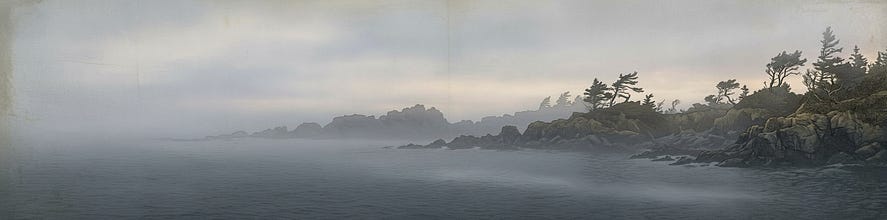
The salt marsh was blanketed in a thick, low fog—a heavy Maine sea-smoke that smelled of wet slate, mud-flats, and frozen grass. The sky above was clear, cold, and pin-pricked with distant stars, dominated by a pale, merciless moon that hung over the York River like a dead eye.
Instead of heading up the dirt path to his slate-roofed cottage, Eben turned toward the eastern ridge.
The ridge was a high, sheer spine of glacial granite, choked with stunted oak and wind-blasted pitch pine, rising eighty feet above Old Mill Creek. It was the highest point on the lower river, the place where old Alexander Junkins used to stand with a spyglass in the 1700s, watching for the tall masts of Sayward’s ocean schooners creeping up the channel from York Harbor.
Eben hadn’t climbed it since he was a boy holding his father’s coat-tails. A miller had no call to climb hills; his world was six feet of water-deck and four hours of sleep.
Halfway up, his breath failed him. He crouched against the rock, one palm pressed to his chest, and listened to the mill below beating on without him. The sound came through the fog in pieces: saw, wheel, pawl, water. For one dizzy moment the whole valley seemed to breathe through his ribs. Then the tide struck the outer gate again, faint but certain, and Eben forced himself upward.
His boots slipped on the frozen lichens. The granite was unforgiving, scraping the leather off his knees as he scrambled upward through the dark. Every breath burned his throat. His left hand—stiff and useless from the afternoon’s jammed pike—throbbed in time with his racing pulse.
“Watch your feet, ya gawmy fool,” he growled at himself, gasping as a loose slab of slate slid out beneath his heel.
He crested the ridge, grabbing the low branch of a scrub pine to steady his weight.
He pulled the brass lantern up, shading the top glass with his hat so the glare wouldn’t blind his night-vision, and looked east down the winding bed of Old Mill Creek toward the ocean.
The breath died in his lungs.
There was no river.
There was no channel winding out to York Harbor. There were no mud-flats, no tide-gut, no salt-reach.
Down in the valley where the river had run for ten thousand years, there was only a colossal, stagnant ocean of timber.
Planks. Thousands upon tens of thousands of sawed pine planks, square-cut timber beams, and peeled hemlock joists, stacked forty feet deep from bank to bank. They filled the valley like a gray, rotting glacier: lower layers black with silt and marsh-grass, middle layers split gray by frost, and at the top, spilling straight from the mill’s discharge chute, the clean yellow-white boards he had sawed yesterday, last week, last month, last decade.
The smell reached him next. Not clean pine. Not river mud. It was the sour, breathing stench of timber drowned and raised and drowned again, sap fermented into rot, salt locked inside grain, moss growing in the seams between boards. Somewhere below, a loose plank shifted. Then another. The sound carried across the valley in a dry wooden whisper, as if the dead river were settling in its sleep.
He tried to remember the last stranger who had come up the creek road. A tax man, perhaps. A peddler with blue hands and a lame mare. Or had that been before his mother died? Years had collapsed into tide marks. Faces had gone dim. Only the wheel remained exact: slack, head, gate, grease, saw, sleep, wake, slack again.
The river hadn’t carried a board to the sea in fifty years. The channel had silted shut beneath the weight of his family’s own uncollected labor.
The mill had been feeding itself. Logs from the drowned pond, boards through the iron saw, planks spat into a landlocked grave of wood, loose debris dragged back by tide and churned again into pulp.
Eben dropped to his knees on the cold granite.
The lantern slipped from his hand, rolling across the rock shelf and shattering its glass envelope against a ledge. The small oil flame sputtered, flared high, and died out.
In the pale, silver moonlight, the valley of dead wood stretched endlessly into the white fog.
“Lard Jesus...” he whispered, the old coastal phrase slipping out like a bleed of blood. “Lard dyin’ Jesus...”
He looked back toward the mill.
From up on the high ridge, the installation looked tiny—a black, timber barn wedged into the granite gap, surrounded by the dark, mirror-like eye of the full mill pond.
As he watched, the logic of the trap closed around his neck like an iron collar.
His hand went to the awl in his belt before he knew he had reached for it. One twist against the lintel would scar Alexander’s rule down to pale wood. He pictured the clean wound of it, the old letters split and spoiled. His wrist trembled. Then he slid the awl back into its sheath and pressed the flap closed with his thumb.
The water in the mill pond was rising.
The mountain streams feeding Old Mill Creek kept pouring fresh water into the reservoir behind the dam. The Atlantic was creeping back in, readying itself against the outer gates.
For one clean second, Eben imagined doing nothing. Not failing by weakness. Not missing the tide by accident. Choosing. He imagined walking to the cottage, lying down on the narrow bed, and letting the pond climb the walls plank by plank. Let the mill drown itself. Let the wheel drink the house. Let the whole cursed inheritance go under.
From below, the wheel gave a single hard knock. Not the loose clatter of old teeth, not the settling of timber. A knock, deliberate as a fist against a door.
If he stopped. If he lay down in his cot and let his stove up body rest... if he missed a single tide... if he refused to open the sluice gate...
The mill pond would overflow.
The water would rise six inches over the masonry lip, breach the dirt wing-walls, and wash out the foundations of the keeper’s cottage. It would drown his bed, collapse the timber frame, and drag him into the black, mud-bottomed gut while he slept.
Every board in the valley proved the work had failed. Every inch of rising water proved he had to do it again.
The machine did not care. No river. No ships. No merchants. No Saywards. Only headwater, gate, wheel, and tide.
Every twelve hours and twenty-five minutes, the head had to be released—not for Crown or wage or harbor, but to keep the pond from climbing the walls while he slept.
He thought of dynamite, though there was none. Fire, though the valley was soaked through with fog and salt. A new channel cut by hand, laughable as prayer: himself waist-deep in silt with a shovel, racing the Atlantic, digging against fifty years of timber packed tighter than stone.
He was bound to the wheel by water, habit, and the narrow height between his bed and the flood.
Down in the dark pit, a low, ominous sound echoed up the granite valley.
THUMP-CRACK.
The turn of the tide. The Atlantic was hitting the outer swinging gates.
The four-hour window was closing. The head was building. The iron gear was waiting for the tallow.
Eben McIntire Junkins stood up on his ruined knees, turned his back to the moonlight, and began the long, wet slide back down into the dark.
The slide down the ridge took the skin off his palms, but Eben barely felt it. His mind was no longer floating in the hazy dwam of sleep loss; it was crystallized, hard and cold as river ice.
He hit the wet hemlock deck of the mill pit just as the first grey fingers of dawn began to bleed through the fog. The moon was setting, but its pull remained absolute.
The raceway had gone dead still. Slack water was ending. The Atlantic pressed against the lower timber gates; behind the dam, twenty-two feet of trapped head pressed against the upper sluice. The two bodies of water locked in a silent, massive vise, with the Junkins mill wedged directly in the jaws.
“Right out straight, boy,” Eben muttered, his voice a flat, dead rasp. “Right out straight.”
He did not light another lantern. He did not need light. His hands knew every grain of the oak levers, every iron tooth on the winch drum, every greasy, cold inch of the water-deck.
He stepped up to the main pry-bar.
His body fought him. The left knee was so swollen it would no longer bend, locked stiff like a spruce timber. His shoulder groaned as he threw his arm over the oak bar. Every joint in his frame was stove up, screaming against the friction of fifty years of damp night air.
He didn’t just push—he abandoned his body to the bar. He kicked his good foot out, threw his ribs flat against the oak, and let gravity take him down.
NRRGH-CRACK.
The maple gear teeth bit into the iron pawl.
The upper sluice gate groaned upward three inches. A torrent of trapped, black pond water exploded through the gap, smashing into the overshot wheel. The building shuddered, the floorboards vibrating so violently that small chips of dried tallow rattled out of the joinery.
SHHH-CLACK. SHHH-CLACK.
The giant saw blade lurched back into its rhythmic stride, slicing cold air, sawing nothing.
Eben lay on his back on the wet timber deck, staring up into the dark joists of the roof, his chest heaving in shallow, ragged spikes. A thick, copper taste filled his mouth.
In the dark above the gear pit, something like a voice moved with the water. Holding the head, Junkins? Eben opened his eyes. Nobody stood by the pier. Nobody leaned in a dry cloak beyond the lantern light. Still the question remained, polite and cold, tucked inside the wheel’s rhythm.
The saw’s rhythm caught for half a beat and came on again changed. Hold-the-head. Hold-the-head. Eben stared into the joists, but there was only water, timber, and the blind push of the wheel.
Above him, the saw kept driving its carriage forward. The wooden gears turned. Down below, the water wheel churned the dark, recycled foam, spitting it down the raceway toward the mountain of rotted, sawed timber choking the dead valley.
The head was falling. The house above his head would stay dry for another twelve hours and twenty-five minutes.
He turned his head slowly to the side.
There, resting on the deck three inches from his nose, was the red lead stamp on the pine plank he had hauled up with the pike pole: E.J.
Eben stretched out a stiff, dirt-caked hand. His thumb, broad and calloused, brushed over the carved letters.
He didn’t scream. He didn’t weep. He simply closed his eyes, his thumb still resting on the red letters, and listened to the roar of the water—the endless, deafening, mechanical heart of a machine that would never stop, turning for a world that was no longer there, holding him three inches above the flood because his hands, ruined as they were, still knew how.
Clack-clack-clack-CRACK.
Beyond the walls, dawn found the valley exactly as night had left it: fog lying low over the dead timber, the pond sinking by inches, the tide shouldering its way back from the sea. No ship waited in York Harbor. No clerk opened a ledger in Boston. No living man knew the mill was still at work.
Outside, the moon crept fifty minutes further down the sky.