
The Boots of Silas Walsh
A Crown surveyor's instruments stop agreeing with the earth.

The boots of Silas “Sye” Walsh had measured the three-quarter mile between the salt marsh and the old stone boundary wall every afternoon for forty years. He didn’t need a Gunter’s chain to know the distance; his hips knew the rise of the crushed gravel road, his knees knew where the iron survey pins bit into the peat, and his lungs knew exactly when the cold, salt fog rolling off the bay would meet him.
It was the same rhythm his father had taught him when Sye was an eighteen-year-old apprentice holding a striped maple rod in the high clover—the steady, mechanical pace of a man who believed that an acre measured today was an acre forever.
His father had made a religion of it. Old Thomas Walsh would set the rod boy in one meadow and the chainmen in another and make Sye call the count until his throat went raw: ten links, twenty, thirty, chain. If Sye wandered with his eyes, Thomas would rap the maple rod against his boot and say, “Look where you’re to, not where you hopes you’re going.” The boy had not understood then that his father was teaching him more than survey work. He was teaching him how to stay sane on a coast where fog erased houses, where snow leveled roads and marsh, where a man could die ten yards from his own door if he mistook a bog hole for frozen ground.
A measured thing could be trusted. A measured thing had behaved itself before God and Crown. The island might be tilted shale, black bog, wet barrens, glacial erratics, and tuckamore bent flat by Atlantic wind, but put a chain across it and the land had to confess its shape.
After Thomas died, Sye had walked those same distances more often than duty required, not because the Crown needed them checked, but because a measured road could still lead him to the grave. The paces kept his father fixed in the world.
“Whaddya at, Sye?”
The voice belonged to old Skipper Ned, leaning over a weathered fish flake as Sye stepped past the last house of the outport.
“This is it, Ned,” Sye muttered, his voice carrying the soft, rhythmic lilt of the Southern Shore. He adjusted the brass transit case slung over his shoulder. “Just checking the metes and bounds before the fall gales tear up the cove.”
Ned nodded, turning back to his nets. “She’s lookin’ best kind out there today, mind the tide.”
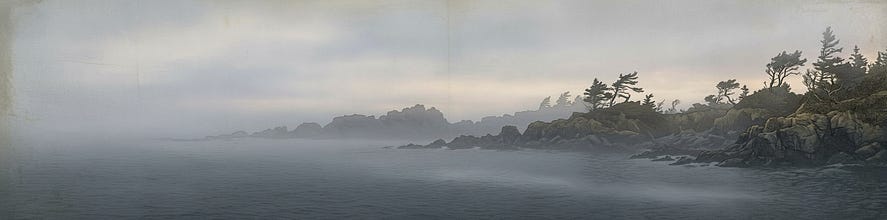
It was looking best kind, though the day had gone strangely quiet. The water lay flat as tin; the gray horizon was stitched to the sky by a clean, sharp line of fog; and every sound from the outport seemed wrapped in wool before it reached him. Even the gulls had drawn back from the cove. Their absence left a hollow over the roofs, a space where cries and wingbeats should have been. Sye struck his boots against the gravel, keeping his mechanical pace. One thousand two hundred paces to the stone wall. That was the law of the land. That was the physical geography he had sworn to uphold as a Crown surveyor.
Even the small things confirmed him. The cracked boulder shaped like a sheep’s skull sat twenty-three paces beyond Mrs. Kinsella’s gate. The shallow ditch where the road sweated rust-colored water crossed underfoot at one hundred and twelve. The crooked spruce, grown sideways as if ashamed of standing upright, leaned over the north verge at three hundred exact. Sye did not count these things anymore. His body did. His boots had a memory more faithful than paper.
At the sheep-skull stone, he touched two fingers to the split in the granite, as he always did, and found it slick with fog, cold enough to sting the pads of his fingers until they tightened against the stone. Twenty-three paces. Correct. At the rust ditch, his right heel sank into the same orange seep it had known since he was thirty, the mud sucking at the welt of his boot and releasing a sour mineral smell like old blood and wet pennies. One hundred and twelve. Correct. At the crooked spruce, he ducked his head beneath the wet black branches and smelled the clean resin where last winter’s ice had broken a limb.
Drops ticked from the needles onto the back of his neck and slid under his collar in cold threads. Three hundred. Correct.
Then the road repeated the ditch. It did not offer a similar ditch, or another place where water had cut the gravel. It gave him the same one back, complete with the flat stone, the braid of dead grass, and the thumb-sized crab shell Ned’s grandson had dropped there in July.
Sye stopped with his left boot on dry gravel and his right boot hovering above a second ribbon of rust-colored water cutting across the road. It was not like the first ditch. It was the first ditch: the same flat stone half-buried in the runnel, the same braid of dead grass snagged on the downstream lip, the same thumb-sized crab shell Ned’s grandson had dropped there in July. Sye looked back, expecting to see the first ditch behind him. Fog folded over the road. There was nothing but white.
The second ditch made the same small sounds as the first: water ticking over the flat stone, a bubble breaking in the orange scum, a thread of runoff worrying at the gravel. They were ordinary sounds. That was what sickened him. The world had copied the noise as well as the shape.
For several seconds he did not move. His body waited for the world to correct itself. A gull should cry. Ned should curse at a snagged net. A door should bang somewhere behind him. But the silence held, and in that silence Sye heard the first small, shameful sound of his own fear: his teeth clicking together.
He walked. The fog crept inward, not rolling so much as arriving, laying itself over the iron survey pins he had driven into the soil decades ago. One by one, the small points of metal vanished. The road kept its shape under his boots, but the world beyond its edges seemed to hold its breath.
He walked until his thighs began to ache.
Sye stopped. The road ahead remained unaltered—crushed gray stone, flanked by stunted tuckamore trees and the black mud of the mash. The fog had thickened into a white, seamless wall. It pressed close enough to hide the ditches, the fence lines, even the slope of the road. He turned around. The outport was gone, erased by the mist.
He looked down at his boots. His joints felt the heavy, draining ache of a three-mile march, yet the landscape around him had not shifted.
The gravel road beneath him was stretching in secret, blooming outward into a vast, silent pocket of land that no mapmaker had ever drawn. It made no sound while it did so. No crack of stone, no tearing root, no groan of frost-heaved earth—only the soft scrape of his own breathing, suddenly too loud inside the fog, and the faint gritty shift of gravel settling under his soles where no slope had been a moment before.
“Lard tunderin’ Jesus,” Sye whispered into the fog.
He spun on his heel, his boots skidding on the damp gravel. If the road ahead was long, the road behind must be short; he had only just left Ned’s flake. He began to march back toward the outport, his stride breaking into a heavy-heeled trudge.
He walked for twenty minutes, his eyes straining through the fog for the shape of Ned’s roofline. Nothing appeared. The road simply unspooled beneath him, an identical ribbon of crushed gray stone bordered by the same unchanging tuckamore branches.
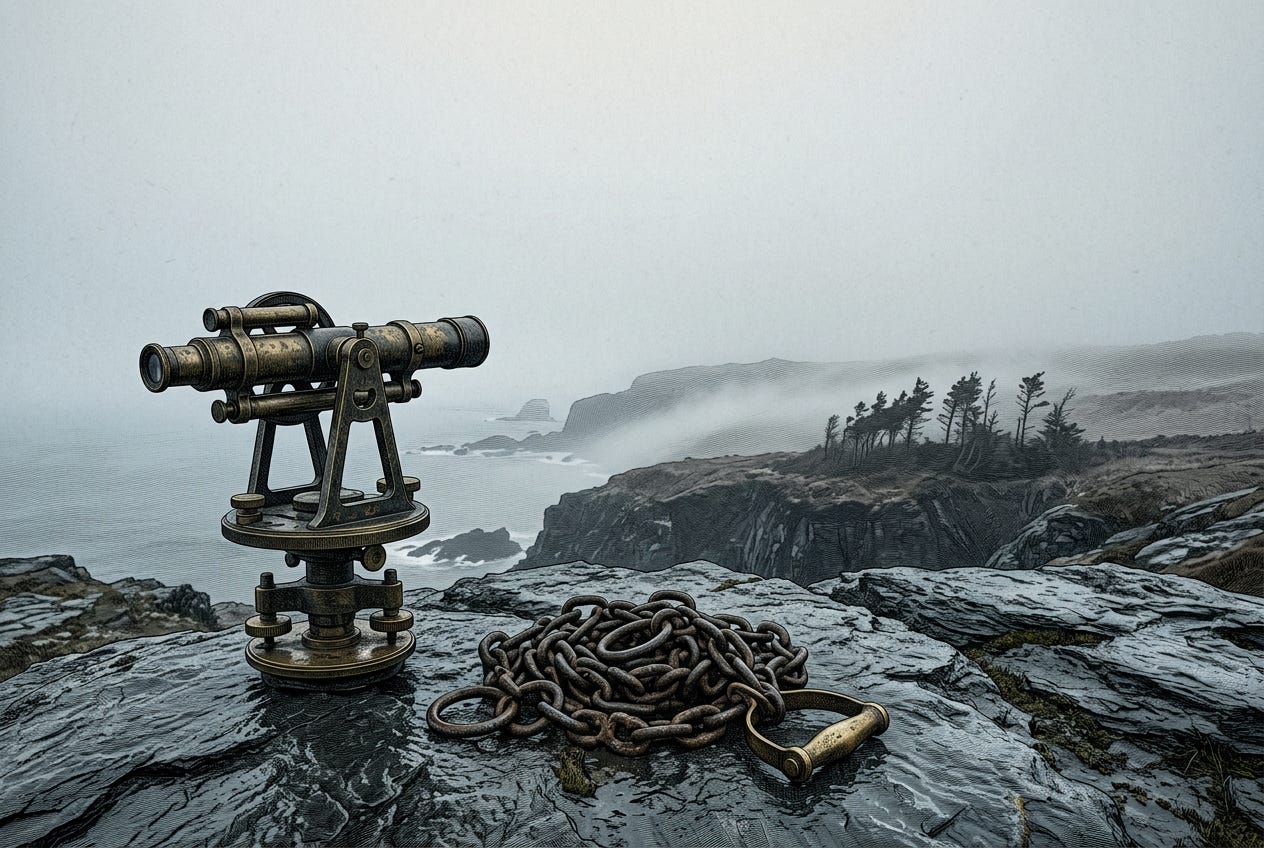
Sye unbuckled his brass transit and set up the heavy wooden tripod directly in the middle of the road. His fingers were stiff, but they moved with forty years of automatic precision. He leveled the instrument until the spirit bubble rested dead between the black lines. He pulled the Gunter’s chain from his hip—a heavy, hundred-link length of linked iron. He pinned one end into the gravel with a steel survey arrow and walked backward, letting the links drag through the dirt.
When the chain snapped taut, he looked down. It was exactly sixty-six feet long. One hundred links. Physical law held true in his hands, clean and obedient, as if the universe had agreed to the instrument and betrayed only the ground.
The taut chain sang once in the fog, a low iron note that traveled into the white and did not return. Sye waited for an echo from stone or house or cliff. None came. The sound seemed to be swallowed link by link.
He tried the simple explanations first because a man owed the world that courtesy. Fog fooled the eye. Tide air bent light. A tired hip shortened the stride. A hidden dip in the road could make a chain look wrong through glass. He wiped the transit lens with his sleeve, checked the brass screws for play, and lifted the needle of his compass away from the iron links in case the chain itself was pulling the instrument crooked. Everything answered as it should. The tools were not failing. They were agreeing too well.
But when he stepped back to the transit and looked through the glass lens to sight the survey arrow, his breath hitched. Through the magnification, the iron pin didn’t look sixty-six feet away. It looked a quarter-mile distant, a tiny, shivering speck drowning in a gray plain of elongated dirt. He checked the spirit bubble. The instrument was level. The distance inside the chain links was stretching like wet dough.
He jerked back from the eyepiece as if it had burned him, the brass rim leaving a cold ache in the bone above his eye. The chain lay at his feet, honest iron, each link wet and cold and exactly where it ought to be. When he nudged it with his boot, the links rasped against one another with a weight he could feel through the sole. That was worse than a broken instrument. A broken instrument could be cursed, repaired, replaced. This was a faithful tool reporting an unfaithful world.
Sye walked to the arrow again and touched it. Close. Real. Sixty-six feet under his palm. The steel was wet enough to chill his bones through the skin, and when he let go, the smell of iron clung to his fingers. Then he turned back toward the transit and saw the tripod standing impossibly remote, as if he were looking at it across a drained bay at low tide. His own bootprints lay between him and it, but they were spaced wrong. The first prints were normal. The next pair had stretched farther apart. Then farther. Ten yards before the tripod, the prints were enormous distances from one another, each impression crisp and ordinary, each separated by a gap no human stride could cross.
Then, from somewhere deep within the expanding pocket of land, a sound drifted through the fog. It was the sharp clack-clack-clack of cod splitters working at a wooden stage, followed by the faint murmur of voices. Beneath it came the creak of rope, the slap of a wet fish on boards, the hollow knock of a punt against a wharf that was no longer there.
The sounds arrived out of order: first the knife on bone, then the breath before speech, then a laugh that cut off before it began.
Sye took a step toward the sound, into the high grass of the mash. But as he listened, the voices changed.
The pitch of the chatter pulled thin. A single greeting—Whaddya at?—stretched across a full minute, each syllable dropping lower until the familiar lilt sounded like the seabed shifting under the island.
Sye dropped to one knee in the wet gravel and unbuckled his field ledger. The cover was dark, oil-stained leather, worn smooth at the corners. Inside were hundreds of pages of crisp copperplate hand—every property line from the harbor mouth to the high tuckamore ridges recorded in precise chains and links.
He flipped to a fresh page. He took his carpenter’s lead and recorded the station:
October 14. 14:15 hrs. Fog thick, wind SSE. Stationed on the Parsons Road.
He stood up, took his steel notebook rule, and walked the length of the iron links again, counting every one. One hundred links. Sixty-six feet.
Then he looked back at his tripod. Through the mist, the wooden legs of his transit looked smaller than a pocketknife, standing on a horizon that seemed to stretch into a featureless prairie.
The fog flattened everything it touched. Near stones lost their edges. Grass became a dark nap against the ground. The tripod, his good instrument, looked like a black insect pinned on the far rim of a world that had no rim.
Sye knelt in the damp peat and opened the ledger across his thigh. He drew a straight line representing sixty-six feet. Then he tried to draw the visual line—the magnified, elongated distance his eyes recorded. To make the diagram fit the grid, he had to draw the line off the edge of the paper, across the leather cover, and onto the wet oilskin of his knee.
The math was refusing the paper.
He tried triangulation next, because triangulation had settled lawsuits, inheritances, fish-room quarrels, and one bitter churchyard dispute involving a grave dug six inches over a family line. The steeple of St. Bride’s should have been southwest, hidden by fog but fixed in relation to the lighthouse ridge and the eastern head. He set the transit, sighted where the steeple ought to be, and waited for the fog to thin.
For one breath it did. The white curtain opened and showed him the church steeple close enough to touch, rising from the mash at the end of his chain. Its bell rope hung outside the belfry window and moved once in a wind he could not feel. Then the fog closed. When he swung the glass toward the lighthouse ridge, the same steeple appeared again, smaller now, perched on the far granite rise. He turned east toward the cliffs and saw it a third time, black against the surf haze. Three bearings. One church.
The bell rope moved again. This time Sye heard the bell answer from all three directions, three dull notes arriving one after another through the fog. Not echoes. Echoes faded.
These were separate bells, each claiming to be the true one.
After the third note, the fog held the vibration. It trembled in the air around his ears, in the hollow behind his teeth, in the wet leather strap across his chest. The bell had stopped, but the sound remained, trapped with him inside the white.
If distance could stretch without adding dirt, if a church could stand in three places and ring three different truths, then there was no law left on the island. No deeds. No Crown land. No home to walk back to. No grave that could be found twice.
That last thought struck him harder than the rest. Sye had laid out his father’s grave himself on a raw November morning, long after Thomas Walsh’s hands had gone still and waxy on the kitchen table. The churchyard had been crowded then, every family pressing its dead closer to the church wall as if stone could keep better watch than flesh. Father O’Leary had wanted the plot beside the east fence, but Sye had refused. Thomas Walsh would not lie in a corner guessed at by eye and habit. Sye drove two pegs, pulled the chain, squared the rectangle, and set the headstone where the measure said it must stand.
His mother wept when he measured it. “Leave it be, Sye,” she had said. “A grave is a grave.” But Thomas had taught him different. A grave was not only a hole and a stone. It was the one place grief could return to without wandering. A man needed his dead to stay put. He needed to know that if he walked through fog and weather, past the chapel door and the crooked yew, his father would be there under the same six feet of sod, in the same measured earth, waiting without moving.
Now Sye pictured that headstone standing in three places at once, or none. He pictured his father’s grave opening onto road, bog, cliff, sea. His throat tightened until he could taste lead and peat. If the churchyard could not hold its place, then grief itself had no address. In his mind, the white cross by the churchyard fence slid six inches to the left, then six feet, then vanished behind a curtain of fog.
He set the lead to the paper again, pressing until the graphite tip snapped.
Note: The interior link measures 1 chain by scale. On foot, the same ground will not close.
He added another line beneath it, though the letters came cramped and angry: St. Bride’s appears on three bearings. Name holds. Position does not.
Sye closed the book with a sharp clap and slid it back into his satchel. He looked toward the right side of the road, where the black expanse of the mash stretched toward the unseen cliffs.
“If the road expands,” Sye breathed into the fog, “then I leave the road.”
The crushed gravel gave way under his left heel with a heavy squelch. He stepped straight off the embankment and down into the mash. His heavy leather boots sank three inches into a carpet of wet sphagnum moss and red-stemmed bakeapple leaves. Black water welled up around his eyelets, pressed through the seams, and crawled between his toes, bitter and peat-stained, the cold climbing through his socks as if the bog had found his pulse.
“Watch de glutch, Sye,” he muttered into his collar. “Watch de glutch now.”
To his right, less than three hundred yards off, sat the eastern headland—a shelf of glacial granite where the cliff plummeted eighty feet into the Atlantic. He could hear the ocean out there, pounding its mechanical rhythm against the rock face. The sound had no weather in it, no gulls, no shifting wind, only impact and retreat, impact and retreat, like a great lung working behind a wall.
Whoom. Drag. Whoom.
Thirty paces off the Parsons Road should have brought him to the high granite shelf. He kept walking. Forty paces. Fifty.
The ground did not rise into rock. It stayed soft, wet, and flat. And yet, the ocean stayed right where it was. The whoom-drag of the waves was no louder and no quieter than it had been when he stepped off the gravel.
He tried sound. He stood still, counted his pulse, and marked the break of each wave against the cliff. Whoom. Drag. Seven beats. Whoom. Drag. Seven beats again. If he were moving toward the water, the sound should swell, sharpen, gain spray and stone. It did not. The Atlantic kept the same distance from his ear no matter how far he fought across the moss. It was not far away. It was not near. It had become a fact without a place.
Sye stopped. A sudden, sharp rustle in the low tuckamore to his left made his skin prickle. The branches did not sway afterward. They held their bent shapes as if something had passed through them without touching them at all.
The hush after the rustle was worse than the sound. No bird lifted. No branch clicked back into place. The fog gathered in the hollows between the spruce limbs until each crooked bough looked half-buried, as if the barrens were filling from the ground up.
Out of the low mist, something stepped onto the barrens.
It was an old weathered pine post, four inches square, driven into the soil with a crown of rusted iron wire wrapped around its top. Carved deep into the softened wood were the initials: P.P. — 1894.
The Parsons Property line.
Sye grabbed the top of the pine post. The wood was solid, heavy, and wet. This marker was supposed to sit two miles north of where he was standing, up on the high ridge near the lighthouse road.
He turned in a full circle. The sea still beat from the east with the same seven-count rhythm. The road fog pressed white and blank behind him. But the Parsons post stood under his hand where no post belonged, its carved initials wet and fresh-looking, while the lighthouse ridge that should have held it showed only a pale smear through the mist. On the page in his memory, the coastline kept its hard black hook around the bay. Inside that hook, the marks had begun to trade places.
“No,” Sye said, his voice flat. “No, boy. You go standard.”
He unslung his kit and pulled a steel survey arrow from his belt, driving it into a crack in a slate shelf beside his boot.
“Station One.”
He unclipped the Gunter’s chain, took the brass handle, and marched sixty-six feet until the iron links snapped taut. He drove a second steel arrow into the turf.
“Station Two.”
He turned ninety degrees to his right, paced out another sixty-six feet, and drove his third arrow.
“Station Three.”
Four right angles of sixty-six feet make a perfect square. If he turned ninety degrees one more time and walked sixty-six feet, he would be standing right back at Station One, looking down at his first steel pin.
Sye turned ninety degrees to his right. He raised his sighting scope and leveled the spirit bubble. He looked down the crosshairs to sight his first steel pin.
Through the glass lens, he didn’t see the pin or the slate shelf.
He was looking down an open corridor of crushed gray gravel—the Parsons Road. And standing right in the middle of that road, staring directly back down his scope from a mile away, was his own wooden tripod.
Sye lowered the scope. His hands were completely numb.
He had walked three sides of a sixty-six-foot square in the middle of a bog. The fourth side had opened onto the road.
For the first time, Sye ran. Not far. Three stumbling steps, maybe four, before the bog seized one boot and nearly wrenched his knee sideways. Pain flashed hot up his thigh. He stopped with both hands out like a blind man, panting hard, one foot trapped in the peat’s grip, and hated himself for the wet animal noise he made dragging it free.
Then, Sye smelled coal smoke. The sharp scent of a stove burning dry birch.
It came first as a comfort, which made it cruel. Coal smoke meant walls. Birch smoke meant a stove door, an iron kettle, a hand laid near the fire until the knuckles thawed. Sye turned toward it before he could stop himself. The fog ahead had taken on a color beyond white, a weak amber stain pulsing behind the mist. Then a square of lamplight appeared, low and warm, with a curtain drawn across the bottom half.
Mrs. Kinsella’s kitchen window stood in the barrens.
No house surrounded it. No clapboard wall, no sill stones, no roofline with the crooked chimney that smoked brown in damp weather. Just the window, hung upright in the fog as if the air itself had grown a frame. Behind the glass, a kettle lid rattled on a black stove. A blue enamel cup sat on the table beside a folded dishcloth. The light made a golden patch on the wet moss below it, but there was no floor to cast from and no room to hold it.
“Sye Walsh,” Mrs. Kinsella called from inside. Her voice came through the glass, soft and familiar. “Come in out of that. You’ll freeze the marrow in you.”
He took one step. Heat brushed his face, real enough to sting after the cold. The smell of tea and burned bread came with it, and beneath that the clean starch of laundry drying on a chair. His body leaned toward the warmth. His hands had already begun to lift, ready to find the latch, though the latch hung in empty air and the lower edge of the frame had no wall beneath it.
Then he saw the chair legs. Inside the window, the chair by the stove sat on tilted boards, steep enough that any cup should have slid to the floor. But the cup did not move. The kettle steam rose sideways, bending toward the ceiling that was not there. Mrs. Kinsella’s shadow crossed the curtain from left to right, and at the same moment her voice came from behind him, close to his ear.
“Mind the step, now.”
Sye froze. The warm square of window breathed against him. The fog behind him breathed too. Somewhere inside the room, unseen hands set a plate on a table. The sound was small, porcelain on wood, but it struck him with the force of a door closing. His lifted hand hovered inches from a latch that had no door around it. Heat licked his knuckles. The moss under the window steamed.
He backed away. The lamplight narrowed to a slit. Mrs. Kinsella’s voice followed, losing its woman’s warmth while keeping her accent. “Sure, you’re already in, Sye. You only haven’t found the door yet.”
The window winked out. The smell of tea remained for another breath, then soured into brine and wet rope.
Ten feet away, emerging from the white wall of fog, was the wooden corner of old Skipper Ned’s stage—the fish-drying flake where Ned had been leaning when Sye first stepped out of the outport. But it wasn’t down by the cove water. It was sitting high up on the inland barrens, its split-spruce drying racks jutting into the mist. Drops of salt water fell from the boards and struck the moss beneath with small, patient ticks.
The flake carried its own weather. The boards sweated brine. A shallow pool quivered in a warped plank, reflecting a piece of gray sky that did not match the sky overhead. From underneath came the soft knock of water against pilings, though Sye could see black moss and crowberry stems packed tight below.
Standing at the far end of the flake, his back turned to Sye, was Skipper Ned, working a bone needle through a section of green netting.
“Ned?” Sye choked out. “Ned, boy. We’re in a bad way here.” Ned paused and turned around slowly.
“Whaddya at, Sye?” Ned said, his voice carrying the exact same soft, musical pitch it always did.
“Ned,” Sye took a step forward, his heavy boots thudding against the spruce boards. “De rock is folding, Ned. The boundary lines are gone.”
Ned looked at Sye with mild confusion. “This is it, Sye,” he replied calmly, with the same pause, the same breath, the same small lift of the bone needle as if the world had wound him back to the beginning. “She’s lookin’ best kind out there today, mind the tide.”
Sye walked to the railing and looked over. There was no water. There was only a thick, impenetrable wall of wind-twisted tuckamore branches scraping against the edge of the wooden deck.
Ned stared directly into the dead spruce branches, smiling. “Look at the gulls diving off the point. Gonna be a heavy landing tomorrow.”
“Ned,” Sye grabbed the old man’s shoulder. Under the wool sweater, Ned felt solid and real, dense as soaked timber, but his flesh carried no living warmth through the cloth. “Look at me. There is no water. You’re out in the glutch.”
Ned slowly turned his head. The warmth in his eyes vanished, replaced by an empty flatness. It was not madness Sye saw there. Madness had heat. This was survey-stone cold, old as the ridge and just as patient.
For a moment Sye thought Ned might come back to himself. The old fisherman’s mouth trembled with some buried recognition. His eyes flicked from Sye’s face to the dead tuckamore and down to the boards beneath his boots. He whispered, almost lovingly, “Stay where you’re to till I comes where you’re at.”
The phrase was ordinary, almost comic, the kind of thing shouted across a wharf when a man had one boot on the stage and another in a punt. Ned’s mouth shaped it with the old familiar lilt, but his eyes stayed on the boards, watching the gaps widen between the nails.
“I measured it myself, Sye,” Ned said, his voice taking on the precise, clipped cadence of a Crown land officer. “Twelve hundred paces to the wall. The perimeter holds. Why are you trying to walk off the edge of the map?”
Behind Ned, the spruce flake gave a low groan, the kind of sound timber makes under too much winter ice. The boards lengthened between one nail and the next. Gaps opened in the decking, not by splitting but by distance appearing where wood had been joined.
Damp salt smell rose from those widening seams, though there was no sea below them. The net in Ned’s hands sagged into one of those impossible seams, each knot remaining tied, each mesh widening until it could have caught a horse. Ned kept sewing.
Sye backed away slowly, his boot heels thudding against the spruce planks.
He reached the edge of the stage, turned, and stepped off. His boot plunged six inches into a freezing pocket of black peat—a deep boggy slew hiding at the base of the timber posts. The mud clamped around his ankle with a muscular pull. He tore his leg free with a wet gloop, losing feeling in his toes, and scrambled onto a flat shelf of slobby rock.
He turned back. The fog closed in. In three steps, Ned and his stage were gone.
Something behind the fog took one step after him. The sound was not a footfall. It was the measured clink of iron links being drawn across boards.
Sye stood alone on the rock shelf. He pulled out his pocket compass. He opened the heavy brass lid.
The needle wasn’t spinning. It sat dead still, pointing firmly toward Magnetic North. Gravity still worked. The air was cold, the mud wet, his lungs full. The old forces had not vanished; they had merely withdrawn their usefulness. His compass gave him North, but the rock shelf under his boots seemed to have slipped out from under every map he had ever drawn.
“If North is North,” Sye breathed, “then the coast is East.”
He turned ninety degrees right toward the east and forced his way straight into the wall of tuckamore. He stopped trying to measure. He lowered his head and shoved his body through the rigid lattice of spruce branches. Needles raked his cheeks. Twigs hooked his sleeves and pulled at him like fingers. The branches sprang back against his ribs hard enough to leave dull bruises under the oilskin.
Ten minutes later, his foot found nothing.
Sye pitched forward, landing on cold, loose fragments of shale that slid out from beneath his knees.
He looked up. The fog had been shredded by a cold gale blowing off the salt water. Ragged banners of white tore across the cliff face, showing black rock, then hiding it, then showing it again in slices. It slapped his wet cheeks raw and filled his mouth with the taste of brine. He was crawling on a steep slope of scree hanging over the abyss.
Loose shale clicked and slid beneath his knees, shaving through the cloth of his trousers and biting into the skin beneath. Ten feet below his boots, the cliff dropped straight down into the Atlantic.
He dragged one shaking finger through the wet grit beside him, sketching the old shape of the peninsula from memory: cove, road, church, eastern head. The cliff under his cheek answered the map perfectly. The sea struck the black shelf below exactly where it should. But when he tried to set the road inside that outline, his finger slid through loose shale and stopped over empty air.
Sye let out a ragged, sob-like laugh, pressing his cheek against the wet slate. “I made it,” he whispered into the salt spray. “Lard Jesus, I made de water.”
He laughed because the coast had always been the last argument. Roads could wander. Marsh could swallow landmarks. Men could misremember their fathers. But the Atlantic was the edge of the fact. It had gnawed the same black cliffs since before any Walsh put a chain across Crown land. It had undercut slate, polished granite, hauled shale down in winter storms, and left the high headlands standing like the ribs of something ancient.
He looked down at the foaming surf crashing against the black granite shelf below. And then his smile vanished.
Spray struck his face from below, cold and sharp. At the same moment, smoke rose from the outport chimneys with the slow patience of a village a long walk away. The surf was close enough to salt his lips. The houses were far enough for their windows to wink like pinheads. Both distances touched him at once.
Drifting slowly through the white surf at the base of the cliff—beyond the first white break of surf—was a row of small, identical wooden structures.
They were houses.
The entire outport—the Parsons house, the church, the storehouses, the lane—floated in the ocean, perfectly intact, forming a neat ring around the peninsula. At the center, where roads and yards and gardens should have run together, Sye saw only bare black ground, wet and open to the fog.
The houses did not pitch like wreckage. They kept their lanes. Fences met fences. Clotheslines sagged between kitchens, heavy with wet shirts that dripped into the surf. Smoke rose from chimneys and drifted inland against the wind, carrying the warm smell of coal, boiled tea, and fish oil up to the cliff where no town should have been beneath him. From far below came the ordinary scrape of a chair, the bark of a dog, a woman calling a child in for supper.
The ordinary noises rose from below with no regard for the sea around them. A latch clicked. A kettle lid rattled. Somewhere a spoon struck the inside of a cup three times. Each small domestic sound climbed the cliff and pressed against him harder than the surf, because every one of them insisted the town remained where it had always been.
At the center of that floating ring, where the churchyard should have backed onto the road, he saw a rectangle of raw black peat. It was the exact size and shape of the Parsons Road between Ned’s flake and the stone wall. Not a road now, but a wound: empty, wet, and bottomless.
Then the wound moved. Not far. Only an inch, perhaps two, widening toward him along the cliff top as if the missing road had smelled his boots and was trying to find its owner.
Below him, the church steeple leaned with the swell, still whole, still ringing no bell. A trick of the fog, his mind insisted. Refraction. Light playing sleeveen. “Refraction,” he choked out. “Dat’s all.”
He blinked hard, waiting for the illusion to snap back.
Instead, the fog condensed. The gray wall shrank his horizon down to his own knees. The floating houses below dissolved into a white, featureless void. The sound of the surf grew heavy and muffled, as if the Atlantic itself were being buried beneath a wet mattress. The air pressed against his ears until his own breathing sounded trapped inside his skull.
The satchel strap cut into his shoulder as he rolled onto his side, the leather stiff with salt and peat.
The steel arrow at the chain’s end gave a small click against the slate, though no hand touched it. Sye looked down and saw his own bootprints arranged behind him in a clean line, each impression dark with peat, each one spaced like a mark on a survey page. The last print filled slowly with black water, then held its shape as if waiting for the next measurement.
Sye rolled onto his side and unbuckled his leather satchel. He pulled out his field ledger and flipped to the last blank page.
His lead was broken, but he pressed the jagged graphite stub into the paper. He wrote as Silas Walsh, Crown Surveyor:
Final Entry. Station Outer Limit.
The perimeter holds, but the interior has unraveled. The math did not fail; the ground refused the scale.
Sye closed his ledger, slid it into the leather satchel, slid the compass in beside it, and set the satchel on the slate beside the steel arrow at the chain’s end. Then he sat on the edge of the rock and folded his hands against his chest beneath his heavy oilskins.
The rock beneath his boots did not crumble, but it began to feel frighteningly thin. The cold wind died away, replaced by an absolute silence. Even his coat stopped crackling. Even the blood in his ears seemed to wait for permission to move. Beneath that silence came a pressure, slow and upward, as if the island were drawing one long breath directly under him. The slate seemed to press back against the soles of his boots—not hard enough to throw him, only enough to remind him it could.
He closed his eyes. He pictured the neat red and blue grid lines of his ledger. He pictured his father’s maple survey rod, painted in white and red links, standing straight in the high clover forty years ago.
“Go standard,” Sye whispered into his collar.
The cold slate beneath him changed. It softened, dissolving into the wet sponge of the mash. Cold seeped through his trousers, then warmth, then a crawling numbness that climbed his spine link by link. The ground accepted his weight too gently, giving way around him with the slow insistence of a hand closing. The distant thump of the ocean vanished, replaced by the deep, infinite quiet of an interior that had no center and no boundary.
His lips shaped the next count—ten links, twenty—but no number came. The broken lead slipped from his fingers and disappeared into the moss without a sound. The chain lay slack across the slate, waiting to be taken up. Sye looked at it once, then folded his hands tighter against his chest and did not reach for it.
No one in the outport heard him go. Mrs. Kinsella later said she had seen fog lying over the Parsons Road like wool over a coffin, but she had heard nothing except the church bell striking twice at the wrong hour. Ned claimed Sye had passed him only once and seemed “right enough, if a bit crooked with the weather.” By sunset, the road was clear. By morning, Sye’s house stood square on its sill stones, his supper plate cold on the table, his bed unslept in.
Two days later, the sky over the peninsula was a brilliant blue. The Atlantic was flat and sparkling under the autumn sun.
In that clean weather, the place looked harmless. Sun flashed on the bay. The roofs of the outport sat in their proper rows. Yet no gull crossed the road, and the bright air held a gap where the usual harbor noise should have been. Daylight had not corrected the peninsula; it had only made the error visible without mercy.
Arthur Penney, a junior clerk from the Crown Land Office in St. John’s, walked along the crushed gravel of the Parsons Road. His boots were caked in the black mud of the glutch. Ahead of him walked two local men from the outport, their faces grim.
“He wouldn’t have gone far off the path,” Arthur said, checking his pocket watch. “Mr. Walsh was a man of precise habits. Crown surveyors do not simply wander off.”
Old Skipper Ned paused on the gravel, looking out over the low expanse of the barrens. The coastal plain stretched out exactly as the Crown maps dictated—three hundred yards of wet sphagnum moss and stunted fir trees, ending abruptly at the sharp drop-off of the eastern cliffs.
“He was right here,” Ned said softly. “Right where he does be every October.”
Ned’s answer had come after a pause. Arthur had the sense the old fisherman had chosen which version of the day to give him.
They walked another hundred yards until they found the equipment.
Sitting level in the center of the Parsons Road was Sye’s brass transit. The spirit bubble rested dead center between the black lines. Pinned to the dirt directly beneath the tripod was a steel survey arrow attached to a heavy Gunter’s chain. The iron links stretched off the road, cutting a straight line through the crowberry vines toward the eastern cliffs.
One of the local men crossed himself. The other would not step off the gravel. Ned stood with his cap in both hands and looked not at the chain but at the empty air above it, as if something there might still be leaning over a flake, mending net.
Arthur followed the chain, counting the links. He walked exactly sixty-six feet—one chain.
At the far end, pinned into a slick shelf of exposed slate, was a second steel arrow. Resting neatly beside it was Sye Walsh’s leather satchel.
Arthur knelt. The satchel was dry. He pulled out the field ledger and flipped to the final page. He read Sye’s last entry in the stiff, jagged lead:
Final Entry. Station Outer Limit.
The perimeter holds, but the interior has unraveled. The math did not fail; the ground refused the scale.
Arthur frowned. He looked back at the transit sitting on the road sixty-six feet away. Then he looked toward the sea. The cliffs were right where they belonged. The scale was correct. The math was perfect. That was what made his mouth go dry.
“Nonsense,” Arthur whispered. “The man lost his head.”
He said it for the benefit of the two men more than himself. The sentence had the crisp shape of office truth: an old man, bad weather, confusion, exposure. It sat neatly in the mind, filed under incident and misadventure. Arthur preferred matters that could be filed. Lines, parish names, deed numbers, affidavits—each had its shelf. Even grief, if witnessed properly, could be entered and closed.
Yet the place troubled him. The sun had no warmth on the Parsons Road. It lit the gravel and the bog and the wet backs of the tuckamore, but it did not seem to enter them. Every shadow lay short and black. The chain at his feet threw one straight shadow, while each link threw another slightly apart from it, as though the iron could not agree on where the light came from.
“How long since we left the houses?” Arthur asked. The first local man said, “Ten minutes.”
The other said, “Near an hour.”
Neither man corrected the other. Arthur looked at his pocket watch. The minute hand stood between marks, trembling in a place no maker of watches had bothered to engrave. He snapped the case shut and told himself the spring had taken damp.
Before touching the compass, Arthur tried the transit. He bent to the eyepiece, aligned the crosshairs on the road, and sighted back toward the tripod. Sixty-six feet, he told himself. One chain. The instrument showed him the gravel road running away under bright sun, longer than any road in the parish, with the tripod standing at the far end like a black gallows. He lifted his eye. The tripod sat close enough for a boy to throw a stone at it.
He looked again through the glass. This time the tripod was no larger. The road between had gained a shallow ditch, rust-colored and ticking over a flat stone. Arthur did not remember stepping over such a ditch. Behind him, one of the men drew in a breath through his teeth.
Ned spoke without looking at Arthur. “Stay where you’re to,” he said, soft as a prayer. “Till it comes where you’re at.”
Arthur kept the compass closed for another moment. The sun stood high. The chain lay straight. The men behind him had gone still. Yet the road between his boot and the tripod seemed to wait, as if it knew which instrument he would open next.
He reached into the satchel to retrieve Sye’s brass pocket compass. Arthur opened the heavy lid.
The glass face was clear, but the magnetized needle was not pointing North, nor was it spinning. The steel point had been pulled hard against the lower glass, aimed straight down into the slate beneath his knees.
“What does that mean?” Arthur asked, but the question sounded thin in the open air. No one answered. The bright road had begun to feel enclosed, not by fog this time, but by attention. The barrens watched from both sides. The tuckamore leaned inward. Even the bay seemed to hold its glitter in place.
Arthur stared at the instrument as the sunny afternoon went silent around him. The open compass trembled in his hand, cold sweat slicking the brass rim. From somewhere behind him came the faint clack of a knife on a splitting board, though the stages were far below by the cove, followed by the smell of salt water on dry gravel. The two local men had stopped speaking. Ned was looking at the road now, not the chain, and his lips moved around words Arthur could not hear. Arthur took one step toward the road and began to count. “One,” he said. The second step would not come. His boot hovered over the gravel while the chain behind him gave a small iron clink, though no hand touched it. In St. John’s, in the Crown Land Office, some clean blank page was waiting for his name.