

About The Far Bearing
A bearing is a direction you trust because something told you it was true — a compass, a chart, a set of buoys, a line of blazes cut into bark, a voice that’s led you home a hundred times before. Every trade along the coast and in the woods behind it runs on some version of the same faith: that the tool holds, that the method works, that the thing which has always been reliable will go on being reliable.
The Far Bearing is where that faith runs out.
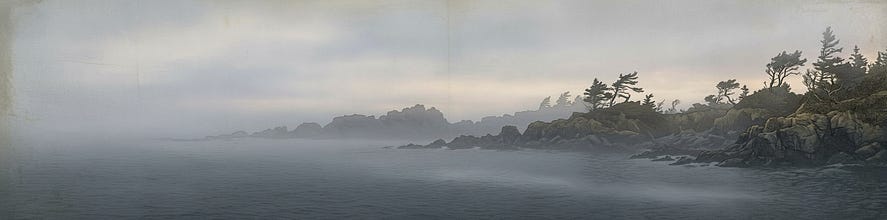
This is a home for literary horror — stories set wherever the charted and the uncharted meet: coastlines from Maine to the Canadian Maritimes, the dark woods inland from them, the older histories layered underneath both. A lobsterman who’s navigated blind fog his whole life by the sound of water on rock — who could always tell you exactly where he was with his eyes shut — and who, one morning, listens and hears the wrong rocks answering back. A deckhand who trusts a knot that no longer holds. A widow’s walk still paced at the top of a sea captain’s house, long after the fence went to rust and the last wife who watched from it died — and a woman up there tonight who reads an incoming tide more accurately than anyone left living, though no one has asked her opinion in a hundred years. The dread here tends to be quiet rather than loud. Nothing jumps out of the dark. Sometimes the tool stops agreeing with the hand that’s holding it. Sometimes it just keeps working, long after anyone was still listening for the answer.
If you’ve read The Boots of Silas Walsh, you already know the shape of what’s here. If you haven’t yet, that’s a fine place to start.
What you’ll get
Free subscribers receive new stories as they’re published — no catch, no fine print, just the work as it goes out into the world.
Paid subscribers get the full archive, including work not available anywhere else, along with early access to new stories before they’re announced publicly.
Founding members are the readers who backed this before there was a track record to point to — with my thanks, and a name in the acknowledgments of any future print collection this becomes.
A word on how these get made
These stories are mine — written, revised, and finished by hand. Where I’ve used editorial tools, including AI, for feedback and craft notes along the way, I’ll say so plainly rather than let a reader wonder. Nothing here is generated; some of it has been discussed.
